
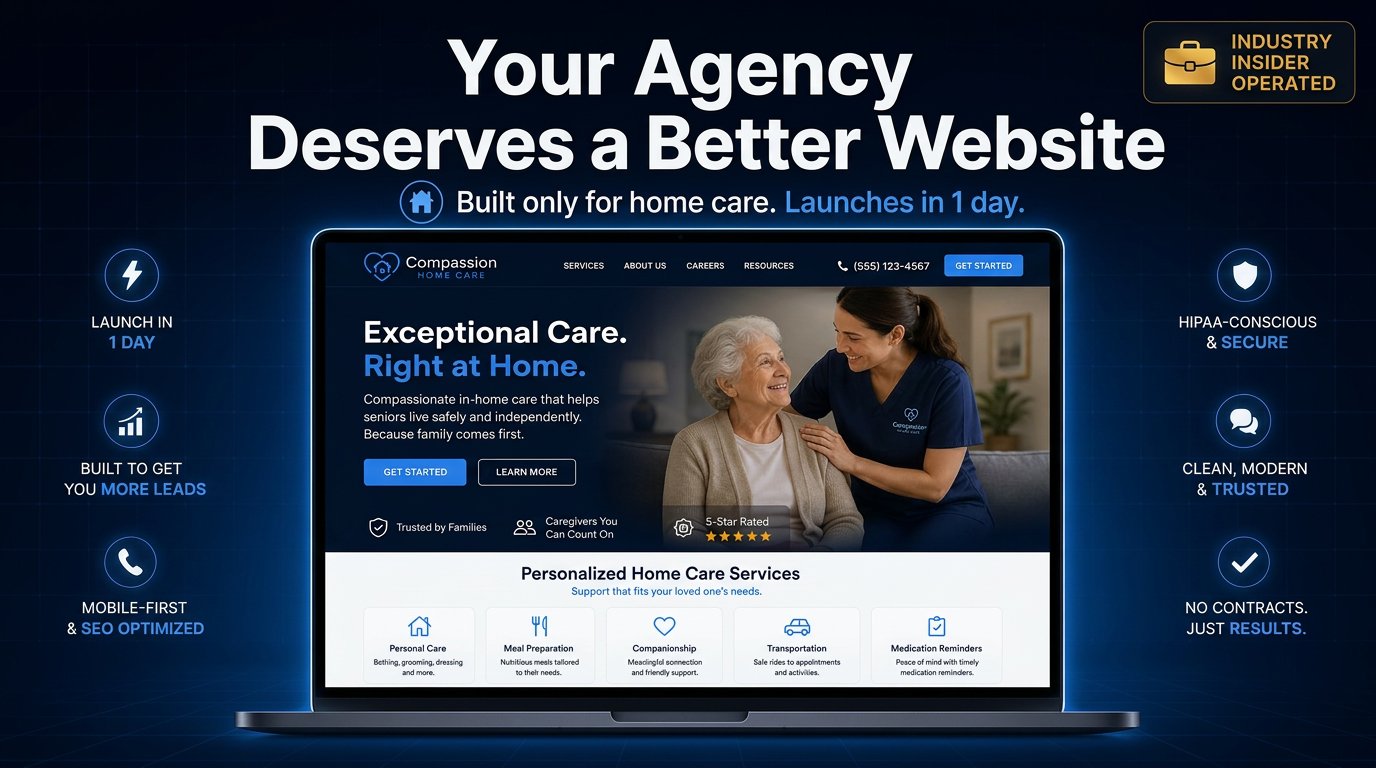
After auditing dozens of home care agency websites, the same problems come up again and again. Some cost agencies leads every single day without anyone realizing it. Others quietly drag down Google rankings over months and years.
This is not about aesthetics. A site can look clean and professional on the surface while silently failing the families who land on it. Here are the eight most common issues I find, and why each one matters more than most agency owners think.
1. No One-Tap Call or Email Button
This one surprises people, but it is one of the highest-impact fixes available for almost no effort.
Most families searching for home care are doing it from their phone. When a visitor has to memorize your phone number, close the browser, open their dialer, and type it in manually, a large percentage of them simply do not do it. That is a real lead, gone.
A one-tap call button eliminates that friction entirely. One touch and the phone is ringing. The same logic applies to email. If contacting you requires more than a single tap, your site is working against you on mobile, which is where most of your traffic is coming from.
The fix: Make sure every page has a sticky or prominently placed click to call button. Test it yourself on your own phone before assuming it works.
2. Thin Service Pages That Do Not Answer the Real Questions
Service pages are some of the most important pages on a home care website, and they are almost universally underdeveloped.
A page that says "We provide personal care assistance" and lists four bullet points is not a service page. It is a placeholder. Families landing on that page are trying to figure out whether your services are right for their situation. They want to know what a typical day looks like, who provides the care, what conditions you support, and whether their loved one qualifies.
There is also a direct SEO consequence. Thin pages send a signal to Google that a page is low value. Search engines reward depth and genuine helpfulness. A well developed service page that actually answers the questions families are asking is both a better experience for the visitor and a stronger ranking signal for Google.
The fix: For each service page, ask yourself: "Does this page answer whether this is right for me?" If the answer is no, it needs more content.
3. No Photos of Real Team Members
Stock photos of smiling strangers do not build trust. Real photos of your actual team do.
Home care is an intensely personal service. A family is deciding whether to let someone into their loved one's home. Seeing the real faces of your coordinator, your caregivers, or your owner goes a long way toward making that feel less like a gamble and more like a relationship.
I consistently see agencies with zero team photos on their site. No headshots, no candid shots from training days, nothing. That is a missed opportunity every single time a prospective client lands on the site.
The fix: Start with your leadership team and care coordinators. Even a small, well lit phone photo is far better than no photo at all.
4. No "What Is Home Care" Page or Section
A lot of families, especially those navigating a care decision for the first time, do not fully understand what home care is, how it differs from home health, or what it actually looks like day to day. They are searching because something has changed and they do not know what options exist.
A website that assumes visitors already understand the industry is leaving a significant portion of its audience behind. More importantly, a page that genuinely educates visitors on what home care is, who it is for, and how it works is exactly the kind of content that Google and AI search engines like ChatGPT and Perplexity reward.
This is what SEO professionals call an EEAT signal, standing for Experience, Expertise, Authoritativeness, and Trustworthiness. When your site educates rather than just sells, it demonstrates that your agency actually understands what it is talking about.
The fix: Add a dedicated page or a substantial section that explains home care in plain language. Write it for someone who has never considered it before.
5. No Explanation of How to Get Started
When families are in crisis, they pick the path of least confusion. If your website does not spell out exactly what happens when someone reaches out, many of them will move on to a site that does.
Getting started with home care can feel overwhelming from the outside. Is there an assessment? How long does it take? Will insurance cover it? What happens on the first day? These are the questions running through a family's mind when they are on your site at midnight after a difficult conversation with a parent.
Walk them through it. A simple "How It Works" section with three or four steps removes a huge amount of anxiety and makes picking up the phone feel much more manageable.
The fix: Create a clear, step by step process section. Keep it simple. "Step 1: Call us for a free consultation. Step 2: We visit and build a care plan together. Step 3: Care begins." That is enough to move someone from hesitation to action.
6. Dense Text Blocks That Nobody Reads
Most visitors skim before they read. That is not a criticism of the audience. That is just how people process information on a screen, especially when they are stressed or in a hurry.
When your page is built around long, unbroken paragraphs, most visitors will not absorb any of it. They will glance at the page, feel overwhelmed, and leave. You only get a deep read after you have earned it with a layout that respects how people actually scan.
Headers, short paragraphs, bullet points, and white space are not design flourishes. They are functional tools that determine whether your message actually lands.
The fix: Go through your key pages and break up any paragraph longer than three or four sentences. Use headers to signal what each section is about. Make it easy for a skimmer to get the main idea in ten seconds.
7. No Information on VA or Medicaid Benefits
If your agency accepts Medicaid or serves veterans through VA benefits, and that information is not clearly on your website, you are leaving a substantial number of potential clients on the table.
Many families do not know that their veteran parent may qualify for home care through the VA Aid and Attendance benefit. Many do not realize that Medicaid may cover in home care in their state. If they do not find that information on your site, they may assume they cannot afford care and stop looking.
A clear, plain language explanation of the programs you accept, who qualifies, and how to get started with those benefits is genuinely helpful to families and makes your agency more competitive in searches where those terms come up.
The fix: If you accept VA or Medicaid, give each one its own dedicated page or section. Explain eligibility in plain terms and tell families exactly what to do next.
8. No Blog
A blog is not a nice to have. For a home care agency trying to compete in local search, it is one of the most powerful tools available.
Every blog post is an additional page that can rank for its own search terms. A post titled "Signs Your Parent Might Need Help at Home" can show up when an adult child searches that exact phrase. A post about Medicaid home care in your state can bring in families who did not even know they were looking for an agency yet. Over time, a library of useful posts builds your authority in Google's eyes in a way that a five page brochure site simply cannot.
The agencies sitting at the top of local search results are almost always the ones publishing content consistently. One genuinely helpful post per month, written for the actual questions families ask, will outperform agencies that publish nothing.
The fix: Start a blog and commit to one post per month. Focus on questions your intake coordinator hears regularly. Write for the family, not for the industry.
The Bottom Line
A home care website is often the first impression a family gets of your agency. In a moment of real stress and uncertainty, your site either earns their trust or sends them somewhere else.
Most of the issues above are fixable without rebuilding your entire site. Some take an afternoon. But they make a meaningful difference in how many families reach out, how your site ranks in Google, and how your agency is perceived before a single conversation ever takes place.
If you are not sure whether your site has any of these problems, we offer a free technical and content audit for home care agencies. We will tell you exactly what we find, with no obligation.