
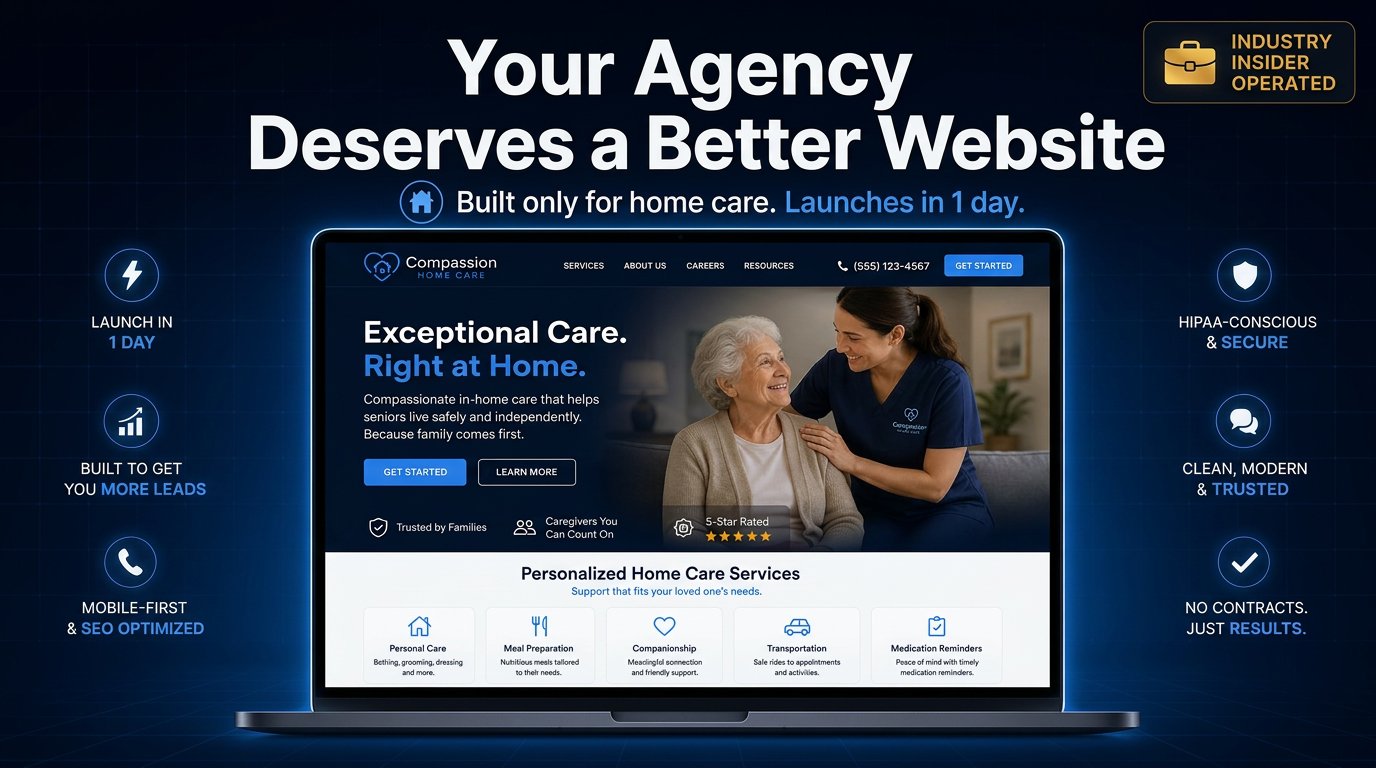
Referral landing pages, trust signals, and lead capture strategies that turn website visitors into paying clients.
Private pay clients are the financial backbone of most home care agencies. They represent higher margins, more schedule flexibility, and relationships built directly with families rather than routed through insurance bureaucracy. But winning private pay clients takes more than having a website. It takes having the right website, one built to earn trust, answer the questions families are already asking, and make it effortless for referral partners to send new clients your way.
This post walks through the strategies that actually move the needle, including one that most agencies are not using at all: dedicated referral landing pages for your healthcare partners.
Why Private Pay Families Make Decisions Differently
When a family is paying out of pocket for home care, the stakes feel personal. They are not handing the decision to an insurance coordinator or following a discharge planner’s list. They are doing their own research, reading your website carefully, comparing you to competitors, and making a judgment call about whether they can trust your agency with someone they love.
That research almost always starts on Google and ends on your website. If your site does not do its job in the first 30 seconds, that family moves on. Here is what your website needs to be doing to keep them engaged.
1. Lead With Trust, Not Features
Private pay families are not primarily shopping for a list of services. They are asking one question: can I trust these people with my parent? Your website needs to answer that question before anything else.
What builds trust on a home care website:
- Real photos of your caregivers and leadership team, not stock photography
- Client and family testimonials placed prominently, not buried at the bottom of a page
- Your caregiver screening and training process described in plain, specific terms
- Clearly displayed credentials, accreditations, and how long you have been serving your community
- A visible, easy way to reach a real person by phone or text
Families evaluating a $6,000 per month private pay arrangement are not going to submit a contact form and wait two days for a callback. Make sure your phone number is in the header of every page and that someone answers it during business hours.
2. Build Dedicated Referral Landing Pages for Your Healthcare Partners
This is the strategy most home care agencies overlook entirely, and it is one of the highest-return things you can add to your website.
Think about who sends you referrals. Hospital discharge planners. Geriatric care managers. Primary care physicians. Memory care facilities when a resident is transitioning home. Senior living communities whose residents need a little extra support. These partners are gold, but right now, when they refer a family to you, that family probably gets a business card or a generic website URL.
A dedicated referral landing page changes the entire experience.
What Is a Referral Landing Page?
A referral landing page is a page on your website built specifically for the patients or clients of one particular partner. It is personalized, professional, and designed to make the handoff from partner to agency feel seamless and trustworthy.
Example: You partner with a local orthopedic surgery center. Patients discharged after hip or knee replacement often need in-home care during recovery. Instead of sending families to your generic homepage, the surgery center gives patients a card that reads: “For in-home recovery support, visit [youragency.com/orthopedic-recovery]”
What goes on a referral landing page:
- A warm, welcoming headline that speaks directly to the patient or family (“Welcome, [Partner Name] Patients and Families”)
- A brief, plain-language description of exactly which services are most relevant to patients from that partner
- A photo and short bio of your intake coordinator so families know who they are calling
- Any special arrangement you have with that partner, such as a complimentary care consultation or priority scheduling
- A streamlined contact form that asks only the essential questions: name, phone number, and when care is needed
- Your partner’s logo or a line acknowledging the relationship to reinforce the trusted referral
When a family lands on a page that feels like it was made for them, conversion rates improve dramatically. It also strengthens your relationship with the referring partner because you are making them look good.
Which Partners Deserve Their Own Page?
- Hospital discharge planning departments
- Orthopedic, cardiac, and oncology practices
- Geriatric care managers and elder law attorneys
- Senior living communities and assisted living facilities
- Primary care and internal medicine practices with large senior patient populations
- Local hospice organizations for families navigating concurrent or post-hospice care
You do not need to build dozens of pages at once. Start with your two or three most active referral sources and build from there. Each page you create is also a new page that can rank in local search results, which compounds the SEO benefit over time.
3. Create a Page Specifically for Families Doing Independent Research
Not every private pay inquiry comes through a referral. A large portion of families find you by searching Google on their own, often at a stressful moment in the middle of the night after a fall, a diagnosis, or a visit home that made it clear something needed to change.
These families need a different kind of page than your homepage. They need something that walks them through the decision clearly, without pressure, and answers the questions running through their minds.
A strong “How to Get Started” page should cover:
- How quickly care can begin after an initial call
- What the intake process looks like, step by step
- How you match caregivers to clients and what happens if the fit is not right
- A transparent explanation of how private pay pricing works, even if exact rates require a conversation
- What families should have ready before they call
Families who find this page are pre-qualifying themselves. They have read your process, understand what to expect, and are far more likely to become clients than someone who stumbled onto your homepage and left after 20 seconds.
4. Use a Simple Free Care Consultation Offer as Your Primary Call to Action
Generic calls to action like “Contact Us” or “Learn More” are weak. They do not tell families what will happen next or give them a reason to act today.
A free care consultation offer does both. It removes the financial risk of reaching out, gives the family a clear next step, and gives your intake team a structured first conversation rather than a cold inquiry.
Strong CTA Example: “Schedule Your Free 30-Minute Care Consultation. No commitment required. We will listen to your situation, explain your options, and help you figure out the right level of support for your family.”
Place this offer on your homepage, on every service page, on your referral landing pages, and at the end of every blog post. Make it easy to say yes.
5. Add a Resource Section That Proves Your Expertise
Private pay families are doing research. Give them something useful to read, and you become the trusted resource rather than just another agency in the search results.
A small library of helpful content builds credibility and keeps families on your website longer, both of which signal to Google that your site is worth recommending.
Content ideas that attract private pay families:
- A plain-language guide to the difference between non-medical home care, home health, and skilled nursing
- A checklist families can use to assess whether a parent needs additional support at home
- A candid post on how to talk to a parent who is resistant to accepting help
- A guide to understanding what private pay home care actually costs and what affects pricing
- A resource page listing local senior services, Area Agency on Aging contacts, and community programs
Each piece of content you publish is another page that can appear in search results, another reason for a family to stay on your site, and another signal to Google that your agency is a trustworthy, authoritative source of information.
6. Make Your Website Work on the Devices Families Actually Use
The majority of families searching for home care are doing it on a smartphone. If your website is difficult to read on a phone, if the text is too small, the buttons are too close together, or the page takes more than three seconds to load, families leave before they ever contact you.
Every website we build at Websites for Home Care is built mobile-first, with fast load times, large readable text, and a click-to-call phone number that works with one tap. These are not extras. They are the baseline for a site that actually converts visitors into clients.
Putting It Together: A Practical Starting Point
If you want to start driving more private pay inquiries through your website, here is a realistic sequence to follow:
- Audit your homepage. Does it build trust immediately? Is your phone number visible without scrolling? Is your primary call to action clear?
- Identify your top two referral partners. Build a simple, personalized landing page for each of them.
- Add or strengthen your “How to Get Started” page so self-referred families know exactly what to expect.
- Replace weak calls to action with a clear, low-pressure consultation offer across every key page.
- Publish one helpful blog post per month targeting questions your intake team hears repeatedly.
None of this requires a complete website overhaul. If your current site was built by someone who understands the home care industry, many of these changes can be made quickly. If it was not, it might be worth a conversation about what a purpose-built site could do for your agency’s growth.
Want a website that actually converts private pay families? Websites for Home Care is a veteran-owned web design company built exclusively for home care agencies. We build referral landing pages, lead capture systems, and SEO-optimized sites that launch in as little as one business day. Schedule your free site audit and consultation today.