
Picture this: a daughter is sitting in the waiting room of her mother's doctor's office. The physician just mentioned that her mother should not be driving anymore and that she may need help at home. The daughter pulls out her phone right there and types "in-home care near me" into Google. She finds your agency, taps the link, and lands on a site that is tiny, hard to read, and has no way to call you without hunting for a number she then has to manually dial.
She closes it and tries the next result.
That is the moment a mobile-unfriendly website costs your agency a real family. Not a hypothetical lead. A real person in a real moment of need, reaching for her phone because that is what people do in 2025.
This post covers why mobile performance is no longer optional for home care agencies, what the data shows, and exactly what a mobile-ready site needs to include to turn those phone searches into inquiries.
The Way Families Search for Home Care Has Changed
If you built your website five or six years ago and have not revisited it seriously since, there is a real chance it was designed with desktop users in mind. That made sense then. It does not make sense now.
The numbers tell a clear story about where attention has shifted.
- 63% of all Google searches in the United States now originate on mobile devices (Statista / StatCounter, 2025). On mobile specifically, Google holds approximately 95% of the search engine market.
- 64% of global web traffic comes from mobile devices as of 2025.
- 71% of all Google search traffic globally originates on mobile devices (GrowthNavigate / SQ Magazine, 2025).
For home care agencies specifically, the mobile trend is even more pronounced than these averages suggest. Adult children researching care options for aging parents are skewing toward smartphones because they are doing that research on the go: between work meetings, in hospital waiting rooms, during a lunch break, or sitting in a parent's living room while the conversation is still happening.
Why This Matters for Home Care. The families most likely to contact your agency are not sitting at a desktop computer with time to spare. They are dealing with a crisis, a transition, or a growing concern, and they are doing their research on a phone. Your website needs to meet them where they actually are, not where you imagine them to be.
Google Made a Decision in July 2024 That Every Agency Needs to Understand
This is not abstract strategy. This is about whether Google will even show your website to families who are searching.
On July 5, 2024, Google completed its full transition to mobile-first indexing. That phrase means exactly what it sounds like: Google now evaluates, crawls, and ranks the mobile version of your website first. If your mobile site has missing content, slow load times, or a broken layout, Google sees that as the version of your site that represents your agency. The desktop version no longer gets to carry the weight.
As Google stated directly: "If your site's content is not accessible at all with a mobile device, it will no longer be indexable." That is not a ranking penalty. That is removal from the index entirely.
For home care agencies operating in competitive local markets, this is the difference between appearing on page one when a family searches "personal care aides in [your city]" and not appearing at all.
What Mobile-First Indexing Actually Evaluates
When Google's mobile crawler visits your site, it is checking for:
- Whether your content is fully accessible on a small screen with no zooming required
- How fast your pages load on a mobile connection
- Whether your text is readable without tapping to enlarge it
- Whether buttons and links are large enough to tap accurately without frustration
- Whether your structured data, title tags, and meta descriptions are consistent between mobile and desktop
- Whether your images are compressed and loading efficiently on cellular bandwidth
The Performance Consequence. Pages in the top five Google results score an average of 70 or higher on mobile page speed tests (Ahrefs, 2024). Speed and rankings correlate directly. Slow mobile pages rarely rank well, regardless of how good the content is.
A Poor Mobile Experience Does Not Just Hurt Rankings. It Loses Families Directly.
Even when a family does find your website through search, a poor mobile experience immediately undoes the work your SEO has done. These are not theoretical concerns.
Speed: The Three-Second Window
Google's own research has established that 53% of mobile users abandon a site that takes longer than three seconds to load. On a home care website, that visitor who left in three seconds may have been a family member who needed to make a decision this week.
The relationship between page speed and outcome is linear and unforgiving:
- A one-second improvement in mobile page speed can increase conversions by 27% (Cloudflare, 2024)
- A one-second delay reduces conversions by up to 20% (Conductor, 2024)
- Reducing load time by just one-tenth of a second can improve bounce rates by 8% (G2, 2024)
- 70% of consumers say page speed directly affects their willingness to engage with a business online (WebFX, 2025)
Usability: The Frustration Factor
Load time is only the first barrier. Once the page loads, the experience on a mobile device has to make sense without any effort from the visitor.
- 48% of users report feeling frustrated and annoyed when they visit a website that is not built for mobile devices (G2, 2024).
- 88% of users say they will not return to a website after a negative experience (Forrester Research, 2024).
Non-responsive design is, according to 73.1% of web designers, the primary reason visitors leave websites (Surrey Web Design research, 2024). That is not a secondary concern. It is the leading cause of visitor abandonment.
For home care agency websites, this matters more than it does for most industries. Your visitors are often older adults or their adult children, both of whom are navigating a high-stakes emotional moment. Confusion on your website does not produce patience. It produces the back button.
The Trust Connection. 74% of users say they are more likely to return to a website that works well on their mobile device (WebFX, 2024). A smooth mobile experience is not just about conversion in the moment. It builds the kind of trust that makes families choose your agency when they are ready to call.
The Click-to-Call Button Is Not a Nice Touch. It Is a Lead Generation Tool.
This is where mobile optimization translates most directly into revenue for home care agencies: phone calls.
When a family finds your site on their phone and they are ready to take action, the most natural next step is not to fill out a web form. It is to call. Your mobile website either makes that effortless or it makes it a friction-filled obstacle.
The Data on Mobile Calls and Conversion
- 70% of all calls to local businesses now originate from click-to-call functionality on mobile search results, Google Maps listings, or business websites (BIA Advisory, 2025).
- 73% of phone calls to local businesses originate specifically from mobile devices (Think with Google).
Phone calls are not just a volume story. They are a quality story:
- Inbound phone calls convert to customers at 10 to 15 times the rate of web form submissions (Conversion Sciences)
- For high-ticket services, phone call leads convert at 30 to 50% compared to 2 to 5% for web form leads (Invoca via SEO Level Up, 2026)
- Mobile visitors to service business websites are 8 times more likely to initiate a phone call than to complete a contact form (CallRail, 2026)
- 61% of businesses rate inbound phone calls as excellent leads, compared to 52% for web form submissions (BIA/Kelsey)
The strategic implication for your website is direct: a tap-to-call button that is visible on every page, works instantly on mobile, and does not require the visitor to scroll or hunt is not a feature. It is your highest-converting lead capture mechanism.
What a Proper Mobile Call Setup Looks Like
- A sticky call button that remains visible as the visitor scrolls, so the option to call is never off screen
- A tappable phone number in your header, using large enough type to tap without zooming
- Repetition of the phone number in the footer as well, since Moz research has found that header plus footer placement increases call volume by 19% compared to footer-only placement
- A local phone number rather than an 800 number, which research consistently shows builds more trust with local families and generates more calls
- Business hours clearly displayed near the phone number, so visitors know whether a person will actually answer
The Friction Penalty. Google's own research has found that nearly half of mobile searchers report they would search for a competitor if click-to-call was not readily available on a business website. In a market where your competitors are just one more search result away, removing that friction is the difference between a call and a lost lead.
What a Mobile-Ready Home Care Website Actually Requires
Mobile optimization is not a single checkbox. It is a combination of technical, design, and content decisions that work together to create an experience that feels effortless on a small screen.
Responsive Design That Adapts to Every Screen
Responsive design means your website layout automatically adjusts to fit any screen size, from a large desktop monitor down to a 5-inch smartphone screen. Text reflows, images resize, and navigation collapses into a format that is usable without pinching and zooming.
This is the foundation. Without it, every other optimization is compromised. Approximately 24% of the top million websites in the world are still not fully mobile-friendly (Siteefy, 2024), which means a meaningful number of your competitors may still be handing you an advantage if your site gets this right.
Page Speed That Meets Mobile Standards
Mobile users are often on cellular connections with variable bandwidth, and they are frequently multitasking. Your site needs to load its most important content immediately. That means:
- Images compressed and served in modern formats such as WebP
- Lazy loading for images and video below the visible screen area
- Minimal render-blocking scripts that delay the first visible content from appearing
- A target load time for your Largest Contentful Paint of under 2.5 seconds
Content Designed for Mobile Reading Behavior
Mobile users scan. They do not read long paragraphs on a small screen with the same patience they might at a desk.
- Short paragraphs (two to three sentences maximum)
- Clear headings that communicate the core message even if the visitor never reads the body copy
- Service descriptions that answer the most common family questions in plain language without jargon
- Contact options visible without scrolling past the first screen
This also aligns directly with health literacy best practices. Home care agencies serve families who are often under stress and operating with reduced cognitive capacity. Clear, scannable content is not just good mobile UX. It is an ethical commitment to the people your agency serves.
Navigation That Works with a Thumb, Not a Cursor
- Tap targets (buttons, links, menu items) that are at least 44 x 44 pixels in size
- Adequate spacing between interactive elements to prevent accidental taps
- A simplified menu structure on mobile, typically a hamburger icon that expands to a clean list
- A phone number that is tappable directly from the navigation bar
Mobile Performance and Local SEO Are the Same Conversation
When a family types "home care agency near me" on their phone, the results they see first are the Google Map Pack: the three local business listings that appear above the organic results. Getting into that Map Pack depends heavily on factors that your website directly influences:
- Your Google Business Profile and its completeness, including photos, business hours, services, and an active review stream
- The consistency of your NAP citations (Name, Address, Phone Number) across your website and all business directories
- The mobile performance of your website as a trust and relevance signal that Google factors into local rankings
- Structured data markup (JSON-LD schema) that tells Google and AI platforms exactly what your agency does, where you serve, and how families can reach you
A mobile site that is slow, unresponsive, or difficult to navigate sends negative engagement signals to Google. Visitors land and leave quickly. Google interprets that as a sign that your site did not deliver what the searcher was looking for, and it adjusts your rankings accordingly.
The inverse is also true. A fast, clear, easy-to-navigate mobile experience keeps families on your site longer, encourages them to read your services pages, and makes them more likely to call. Mobile performance is local SEO performance.
"Near Me" Searches. Searches including the phrase "near me" have grown over 500% in the past three years, and more than 70% of mobile searches are related to local content (Go-Globe, 2025). For a home care agency, the family searching "personal care near me" or "senior companion care near me" is one of the highest-intent visitors you will ever have on your site.
The Honest Assessment: What to Check on Your Current Site Right Now
You do not need a professional audit to identify whether your home care agency website has serious mobile problems. Pull out your phone, go to your website, and ask these questions honestly:
- Does the page load in under three seconds on a cellular connection?
- Can you read the text without pinching or zooming?
- Is your phone number visible on the first screen without scrolling?
- Can you tap the phone number to call directly, or do you have to manually dial?
- Is there a clear button or link to your services page within easy reach of your thumb?
- Do your service descriptions make sense to a stressed family member who has never heard of home care before?
- Is the navigation menu clean and usable on a small screen?
- Are your images loading quickly without distorting the layout?
If any of those answers is no, families are leaving your site every day without contacting you. They are not bouncing because they do not need home care. They are bouncing because the friction of using your website exceeded their patience in a high-pressure moment.
Ready to Find Out Where Your Site Stands?
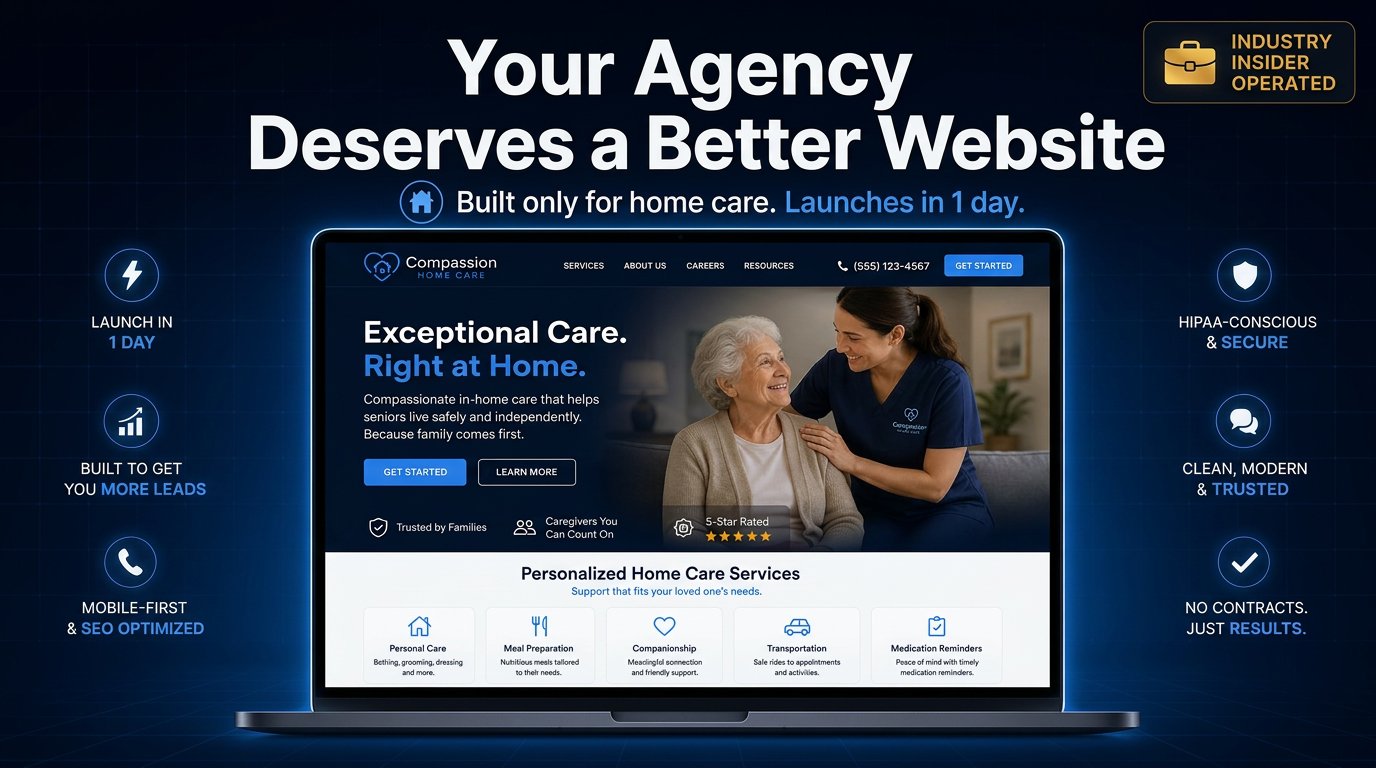
Websites for Home Care builds mobile-first websites exclusively for home care agencies. We include responsive design, mobile speed optimization, click-to-call functionality, and local SEO as standard in every site we build. We can audit your current website and show you exactly how it performs on mobile, what Google is seeing when it crawls it, and what families experience when they land on it from a phone search.
Contact us to schedule your free site audit.
Sources
- StatCounter Global Stats, Search Engine Market Share, Mobile, 2025
- Soax, Mobile vs Desktop Traffic Share Report, 2025
- GrowthNavigate, Google Search Statistics, 2025
- SQ Magazine, Google Search Statistics, 2025
- Go-Globe, State of Mobile Search: Statistics and Trends, 2025
- Google Search Central, Mobile-First Indexing, July 2024
- Ahrefs, Mobile-First Indexing Technical Report, 2024
- Cloudflare, Mobile Page Speed and Conversions, 2024
- Conductor, Mobile Conversion Data, 2024
- G2, Website Statistics and Mobile Behavior Report, 2024
- WebFX, Mobile User Experience Statistics, 2025
- Surrey Web Design / Thunderbolt, Web Design Statistics 2024
- BIA Advisory / Local Commerce Monitor, Click-to-Call Commerce Report, 2025
- Conversion Sciences, Mobile Phone Calls and Conversion Rates
- SEO Level Up, How to Get More Phone Calls from Your Website, 2026
- CallerReady, Click to Call Statistics
- Rook Digital, How Click-to-Call Features Boost Local Conversions on Mobile, 2026
- Siteefy, Website Statistics 2024