
There is a conversation happening in home care agencies all across the country right now. It goes something like this: "We need more clients" followed immediately by "but we cannot afford to spend more on ads."
Here is the thing most agency owners do not hear often enough: you probably do not have a traffic problem. You have an efficiency problem.
The agencies that scale fastest are not the ones dumping the most money into Google or Facebook ads. They are the ones who figured out how to extract more growth from the leads, the clients, and the website they already have. This article breaks down exactly how to do that.
Start With the Math
Before we get into tactics, let us look at what the numbers actually reveal. Say your agency spends $3,000 per month on advertising. That generates roughly 30 leads. You close about 20% of those, landing 6 new clients. With an average client relationship worth $30,000 per year, that is $180,000 in new annual revenue from $36,000 in annual ad spend.
Now here is where it gets interesting. What happens if you improve your close rate from 20% to 30%? Same 30 leads. Same $3,000 in ad spend. But now you are closing 9 clients instead of 6. That is $90,000 in additional annual revenue without a single extra dollar in advertising.
The Growth Equation Most Agencies Ignore. More traffic is only one lever. Conversion rate, lead response speed, client value, and close rate are four more. Pulling any one of them even slightly can outperform a major increase in ad budget.
So where should you focus your energy? Let us walk through it section by section.
Turn More Visitors Into Calls
Your website is working around the clock. The question is whether it is working for you or against you. Most home care agency websites convert somewhere between 1% and 3% of visitors into actual inquiries. That means 97 out of every 100 people who find you leave without doing anything.
The difference between a 2% conversion rate and a 4% conversion rate is not a design trend or a color scheme. It comes down to a few specific, fixable things.
What Families Need to See Immediately
- A headline above the fold that speaks directly to what they are feeling, not what services you offer. "Keeping Mom Safe at Home" lands better than "Providing Compassionate In-Home Care Services."
- A phone number that is visible without scrolling, and clickable on mobile.
- Real photos of your actual caregivers, not stock images. Trust is built on faces, not on generic smiling strangers.
- A clear, specific call to action. "Schedule a Free Care Consultation" converts better than "Contact Us."
- Social proof in the first scroll. Google reviews, certifications, years in business, and number of families served all signal credibility instantly.
- Your service area stated clearly. Families want to know immediately whether you serve their neighborhood.
Speed Is a Conversion Factor Too
Google has made it official: page load speed directly affects your rankings. But it also directly affects whether visitors stay long enough to call you. A page that takes more than three seconds to load loses more than half its visitors before they ever read a word. Every website we build is optimized for Core Web Vitals, the performance benchmarks Google uses as a ranking signal, precisely because speed is both an SEO issue and a conversion issue at the same time.
2x the average improvement in lead volume when a home care website is rebuilt with proper conversion structure, without any increase in ad spend.
Speed Wins Clients
Here is a number that should keep agency owners up at night: studies on lead response time consistently find that the likelihood of converting a lead drops by as much as 80% if you wait longer than five minutes to respond. In home care, where families are often in a stressful, urgent moment when they reach out, that window is even shorter.
Many agencies are losing between 30% and 50% of their leads not because of their pricing, their caregivers, or their services, but simply because someone did not pick up the phone or send a text back quickly enough.
The Systems That Protect Your Leads
- Answer calls within 30 seconds or less during business hours. This is not optional if you want to compete.
- Set up an automated text message that fires the moment someone fills out a contact form on your website. Even a simple "Thank you for reaching out. Someone from our team will call you within the hour" dramatically reduces the chance they call your competitor in the meantime.
- Implement missed call text-back so that anyone who calls and does not reach a live person receives an immediate text. This single feature recovers a significant portion of missed opportunities.
- Use a CRM to track every lead, every follow-up, and every outcome. You cannot improve what you cannot measure.
- Build a follow-up sequence. Most clients need three to five touchpoints before they commit. If your team stops at one call, you are leaving revenue on the table.
A Note on Our Carey AI Chat Assistant. Every website we build can include Carey, an AI chat assistant trained specifically for home care. Carey captures inquiries around the clock, answers common caregiver and family questions, and routes hot leads directly to your team. Families who reach out at 9pm on a Sunday still get an immediate, intelligent response. That is a lead that used to disappear.
Scale Revenue, Not Just Client Count
Growth does not always mean more clients. Sometimes it means better clients. This is one of the most underused levers in the home care industry, and it can dramatically change your agency's financial picture without adding a single new inquiry.
Shifting Toward Private Pay
Medicaid clients are valuable, and serving them is meaningful work. But if your agency relies heavily on Medicaid reimbursement rates, your growth ceiling is low. Private pay clients generate significantly more revenue per hour, give you more flexibility in service design, and are often actively searching online for quality providers.
Your website plays a direct role in which types of clients you attract. Agencies that position themselves clearly as premium, private pay providers, with strong trust signals, professional design, and compelling specialty service descriptions, tend to attract a different caliber of inquiry than those with generic websites.
Lead With Specialty Services
- Dementia and memory care support
- Post-surgery and hospital discharge recovery care
- Parkinson's disease specialized assistance
- Long-term care insurance billing and coordination
- Veterans care programs
Each of these is a search intent. Real families type these exact phrases into Google when they need help. A dedicated page for each specialty, written with health literacy in mind and optimized for local search, can bring in higher-value clients who are specifically looking for what you offer.
Minimum hour requirements are another tool worth considering. Requiring a minimum of three or four hours per visit reduces scheduling complexity, lowers caregiver turnover from short fragmented shifts, and increases revenue per client without increasing client count.
Dominate the Cities You Already Serve
One of the most common mistakes we see in home care websites is a single homepage trying to rank for an entire service area. Google does not rank websites. It ranks pages. And a single page cannot realistically compete for every city and county you serve.
The solution is not more ad spend. It is more pages.
Location Pages That Actually Work
Every website we build for a home care agency includes a dedicated, fully optimized location page for each city in the service area. Not thin duplicate pages with just the city name swapped out, but real pages with locally relevant content, embedded map data, localized reviews, and structured schema markup that tells Google exactly where you operate.
When a family in a neighboring town searches for home care, they see a page written specifically for their community. That specificity builds trust and dramatically increases conversion rates compared to sending them to a generic homepage.
Your Google Business Profile Is Free Real Estate
- Keep your service area, hours, phone number, and photos current.
- Respond to every review, positive and negative. Google interprets engagement as a trust signal.
- Post updates regularly. Photos, announcements, and caregiver spotlights all contribute to profile authority.
- Ask satisfied clients and families for reviews consistently. A steady stream of recent reviews outperforms a large volume of old ones.
Build Traffic That Compounds
Paid advertising stops the moment you stop paying. Search engine optimization builds assets that keep generating traffic for years.
A well-written blog post targeting a question real families are searching for does not expire. It sits on your website, ranking in Google, bringing in readers who are in the research phase of their decision. Over time, a library of these posts builds your agency's authority in Google's eyes and creates multiple entry points for families to discover you.
Topics That Perform Well for Home Care Agencies
- "How much does in-home care cost in [your city]?" This is one of the most searched questions in the category. If you do not have a page answering it, a competitor does.
- "Signs your aging parent may need help at home" targets adult children in the early research stage, the exact moment to build trust and introduce your agency.
- "Home care vs. assisted living: how to decide" captures a high-intent audience weighing major decisions.
- "How to pay for home care: Medicare, Medicaid, and long-term care insurance" positions your agency as an expert resource, not just a service provider.
- Local senior resource guides for your service area establish community authority and attract backlinks from local organizations.
You do not need to publish daily. One thoughtful, well-researched post per month, targeting a specific question your intake coordinators hear regularly, will outperform agencies that never publish anything at all.
The Compounding Effect. Month 1: 1 blog post. Month 12: 12 blog posts, each ranking for its own search terms, bringing in readers around the clock. Month 24: your content library is generating more qualified traffic than most agencies buy with their entire monthly ad budget.
Turn Your Website Into a Recruiting Engine
Here is the honest truth about scaling a home care agency: you cannot take on more clients if you do not have caregivers to serve them. Staffing constraints limit growth more than client demand in most markets. And yet the majority of agency websites treat recruiting as an afterthought.
Your website should be doing two jobs simultaneously: converting families into clients and converting job seekers into applicants. Most agency websites do only one of those jobs, or neither of them well.
What a High-Performing Careers Page Includes
- A compelling, specific headline that speaks to what caregivers actually care about: schedule flexibility, pay, team culture, and the meaning of the work.
- Honest, transparent pay ranges. Hiding compensation information does not attract better candidates; it just delays the conversation.
- Real caregiver testimonials from people currently on your team. Prospective caregivers trust other caregivers far more than they trust management.
- A simple application process. Every additional step in the application form reduces completion rates. Ask only for what you genuinely need to make a first contact.
- A text-to-apply option. Many caregivers are searching on mobile. Text-based application dramatically increases submission rates from this audience.
- Clear information about training, onboarding, and how quickly they can start working.
Agencies that invest in their careers page as seriously as their services page consistently report faster hiring timelines and lower cost per hire, which directly removes the staffing bottleneck that caps their growth.
Raise Your Close Rate
Your intake process is a sales process, and like any process, it can be measured and improved. Even a 5% to 10% improvement in your close rate can fundamentally change your agency's growth trajectory, and it costs nothing in ad spend to achieve it.
Where Most Agencies Lose the Close
- No intake scripting. When different team members handle inquiries differently, outcomes are unpredictable. A consistent, well-practiced intake script ensures that every family gets your agency's best possible first impression.
- Failing to address objections. "It is too expensive" and "We are not ready yet" are the two most common objections in home care. If your team does not have clear, empathetic responses to both, you are losing clients who actually want your services.
- Missing the urgency conversation. Many families are in a reactive mode when they call. They may not realize how quickly they need to act. Helping them understand the realistic timeline for onboarding a caregiver creates appropriate urgency without pressure.
- No follow-up schedule. Most families do not make a decision on the first call. If your team has no structured follow-up plan, you are losing the clients who needed a second conversation to commit.
- Talking about services before understanding needs. The agencies with the highest close rates spend the majority of the intake call listening and asking questions, not pitching.
The Value of a Closed Client. If your average client relationship is worth $30,000 per year and you close 6 clients per month, closing just one additional client per month through improved intake processes adds $360,000 in annual revenue. No additional advertising required.
The Bottom Line
Scaling your home care agency does not require a bigger ad budget. It requires a smarter operation. The agencies that grow the fastest are not necessarily the ones spending the most on marketing. They are the ones who convert more of the traffic they already have, respond to leads faster, close a higher percentage of inquiries, serve higher-value clients, and build content assets that compound over time.
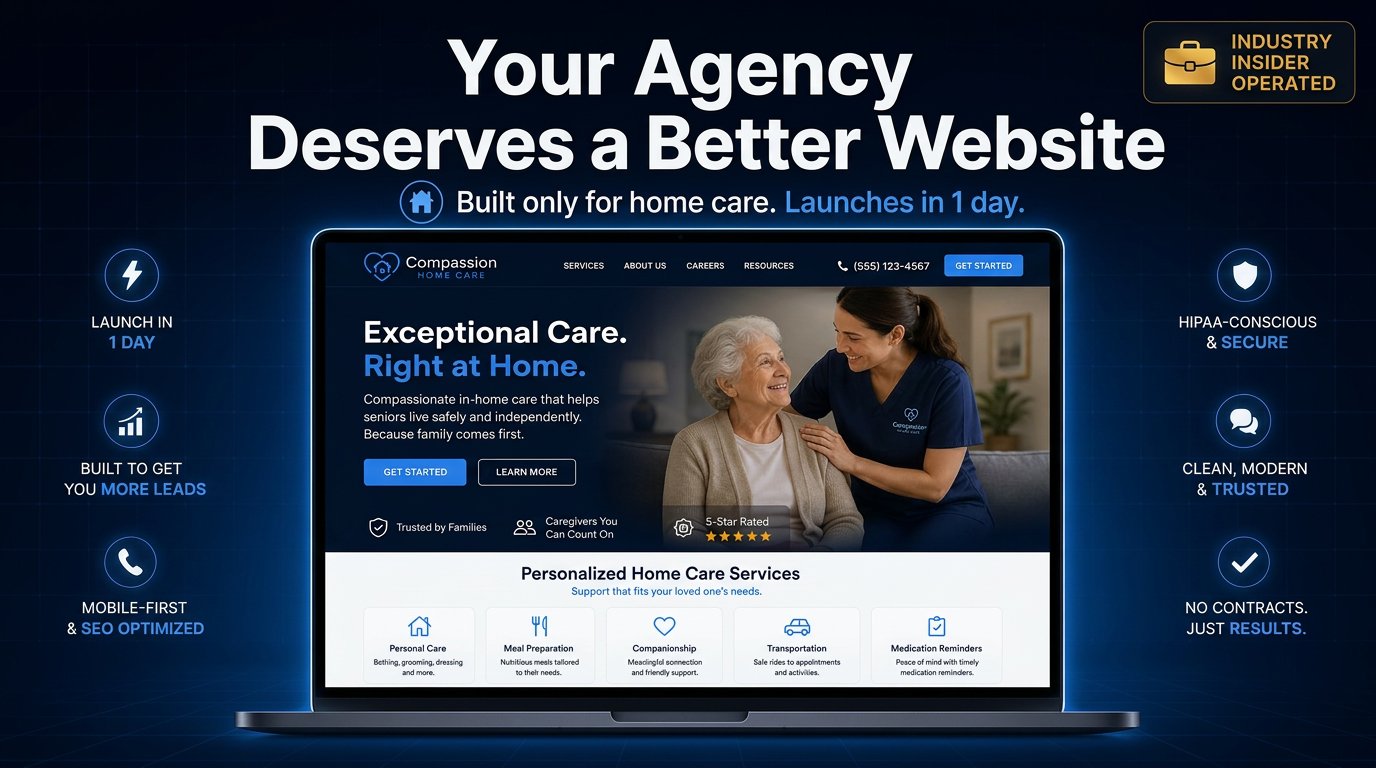
Your website sits at the center of all of this. It is the hub where families evaluate you, where caregivers apply to join your team, and where Google decides whether to send you traffic. When it is built correctly, it is not an expense. It is the most productive member of your team.
If you are not sure whether your current website is doing its job, we offer a free technical audit and consultation for home care agencies. We will look at your site the way Google looks at it, and the way a stressed family at midnight looks at it, and we will tell you exactly where the opportunities are.
Ready to grow without growing your ad spend? Request your free website audit.