
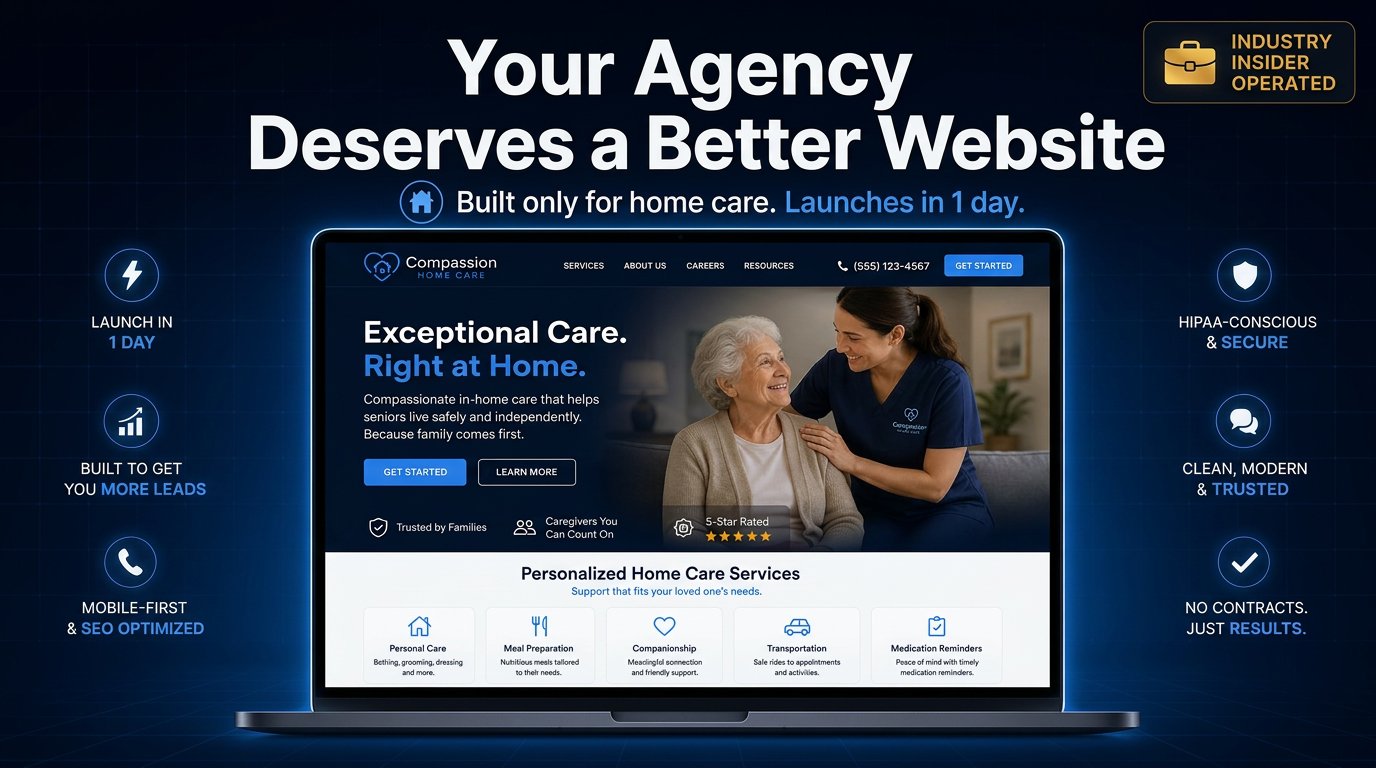
If you run a home care agency, you already know that families reach out to you during some of the hardest moments of their lives. A parent has just been discharged from the hospital. A spouse can no longer safely live alone. An adult child is fielding calls from siblings in three time zones while managing a full-time job of their own.
That family is going to find your website before they ever speak to a single person on your team. What they read in those first few minutes will shape whether they call you, whether they trust you, and whether they believe your agency is the right fit for someone they love.
Health literacy is the reason that moment either works or it does not.
What Is Health Literacy?
Health literacy was formally redefined in 2020 as part of the U.S. government's Healthy People 2030 initiative. The CDC now defines it across two dimensions:
Personal health literacy: The degree to which individuals can find, understand, and use health information and services to make well-informed decisions for themselves and others.
Organizational health literacy: The degree to which organizations equitably enable individuals to find, understand, and use information and services to inform their health-related decisions and actions.
Notice what that second definition places squarely on your shoulders. It is not enough to produce technically accurate information. Your organization bears responsibility for whether the people you serve can actually find it, make sense of it, and put it to use.
The World Health Organization reinforces this framing. According to the WHO Health Literacy Fact Sheet, health literacy means more than being able to read a website or follow a set of prescribed instructions. It encompasses the ability to think critically about health information and to interact with the people and systems that deliver it. That is a high bar, and it demands that everyone who creates health content take it seriously.
The Problem Is Bigger Than Most People Realize
There is a pervasive assumption in health care communications that limited health literacy is somebody else's problem. It happens to people with low education, people who are older, people who did not grow up speaking English. It does not happen to people who are articulate, professional, or well-read.
That assumption is wrong, and it gets home care agencies into trouble every day.
The CDC's Understanding Health Literacy resource is direct on this point. Even people who read well and are entirely comfortable with numbers can face health literacy problems when they are not familiar with medical terms or how the body works, when they are required to interpret statistics or weigh competing risks, when they receive a serious diagnosis and are frightened and disoriented, or when they are managing complicated self-care requirements for a chronic condition.
Every single one of those scenarios describes someone who might be visiting your home care website right now.
The numbers make the scale of this clear. According to data cited by the CDC and UnitedHealth Group, improving health literacy could prevent nearly one million hospital visits and save more than twenty-five billion dollars annually in the United States alone. Thirty-six percent of U.S. adults have basic or below-basic health literacy skills. Only twelve percent of adults have proficient health literacy.
That means the vast majority of people arriving at your website are processing information in a high-stress situation with health literacy skills that fall short of what most health materials assume.
The WHO's fact sheet adds a global dimension that hits close to home: health literacy is a stronger predictor of an individual's health status than income, employment status, education level, or racial and ethnic group. That should stop you in your tracks. We spend enormous energy thinking about demographics, about income brackets, about where people live and what they can afford. And yet the single most powerful predictor of health outcomes is whether or not someone can understand and use health information. That is entirely within your sphere of influence as a website owner.
Why This Is Especially Critical for Home Care Websites
Home care is not an elective purchase. People do not browse your website the way they browse for a new appliance. They arrive under duress, often in the middle of a health crisis, looking for reassurance and clarity.
The WHO notes that health literacy challenges intensify when someone is under stress and must make important health decisions. Home care inquiries are, almost by definition, made under exactly those conditions. A caregiver who just watched a parent fall. A family who received news from a discharge planner that the hospital stay is ending and that care at home will now be required.
If your website communicates clearly, those families feel seen. They understand what you offer, they understand how to get started, and they trust that the people behind the words are competent and caring. If your website communicates poorly, they leave. They call a competitor. Or, worse, they delay getting help at all.
There is also an equity dimension that home care agencies cannot afford to ignore. Limited health literacy is not distributed evenly across the population. Older adults, people who learned English as a second or additional language, and people navigating economic hardship all face compounding health literacy challenges. These are not edge cases for home care. These are your core clients.
Health Literacy Is a Trust Signal
Here is something that does not get said enough: a clearly written website tells families that your agency respects them. Dense medical jargon, confusing intake processes, and unexplained clinical terms signal the opposite. They suggest that your organization is not particularly concerned with whether the person reading your content actually understands it.
The CDC makes the connection between health literacy and trust explicit. Using health literacy best practices, they note, can build trust and advance health equity. Trust is an essential ingredient in a person's willingness to engage in care and to take actions that promote their own health. When families trust your agency from the moment they land on your website, they are more likely to call, more likely to commit to a care plan, and more likely to refer others.
For veteran-owned businesses and mission-driven agencies, that connection between clarity and trust aligns with something deeper than marketing strategy. It is a reflection of your values.
Health Literacy Is an Organizational Responsibility, Not a User Problem
This is the shift that the updated 2020 definition was designed to drive, and it is the one that matters most for how you think about your website.
The older definition of health literacy framed it as a skill that individuals either had or lacked. The new definition from Healthy People 2030 places equal weight on the organization. If a visitor cannot understand your content, that is not entirely their failure. It is, at least in part, yours.
The WHO is equally direct: health literacy is not the sole responsibility of individuals to develop and maintain. All information providers, including organizations delivering health services, are obligated to enable access to trustworthy information in a form that is understandable and actionable for all people.
When you think of your website through this lens, a lot of common design choices look different. Lengthy service descriptions full of clinical terminology. Contact forms that ask confusing intake questions. Pages that bury the most important information three scrolls down in a wall of text. These are not neutral design decisions. They are barriers, and the people they affect most are the people who need your services most urgently.
What Measuring Clear Communication Actually Looks Like
The CDC developed the Clear Communication Index specifically to help organizations evaluate whether their public health materials meet a meaningful standard of clarity. The Index is a research-based scoring tool built on 20 items drawn from scientific literature in communication and related disciplines. It assesses whether materials carry a single clear main message, whether that message appears early and prominently, whether they use active voice and common words, whether numerical information is presented in ways people can actually process, and whether behavioral guidance is specific and actionable.
You do not need to run every page of your website through the Index. But understanding what it measures is useful because those criteria describe exactly what a health-literate home care website does well.
One clear, prominent message per page. Common words instead of clinical jargon. Active voice. Specific, actionable guidance. Numerical information presented simply and in context. That is not a complicated framework. It is a disciplined one.
The Stakes Are Real
Home care agencies invest significant resources in building their reputation, training their staff, and delivering high-quality care. A website that communicates poorly can undercut all of that before a family ever speaks to a member of your team.
Conversely, a website built around health literacy principles does something remarkable. It positions your agency as one that genuinely understands the people it serves. That is a competitive advantage that no amount of paid advertising can replicate, because it is earned by the quality of how you communicate rather than by how loudly you broadcast.
The families searching for home care are counting on you to meet them where they are, not where you think they should be.
Ready to Build a Health-Literate Website?
Understanding why health literacy matters is the first step. The next is knowing how to actually build it into every page, form, and piece of content on your site.
At Websites for Home Care, we design every site around health literacy principles from the ground up because we have seen firsthand how much it matters for the agencies we serve. If you want to go deeper on what that looks like in practice, visit our dedicated resource at websitesforhomecare.com/health-literacy.
Sources
- Centers for Disease Control and Prevention. What Is Health Literacy?
- Centers for Disease Control and Prevention. Understanding Health Literacy
- World Health Organization. Health Literacy Fact Sheet
- Centers for Disease Control and Prevention. The CDC Clear Communication Index