
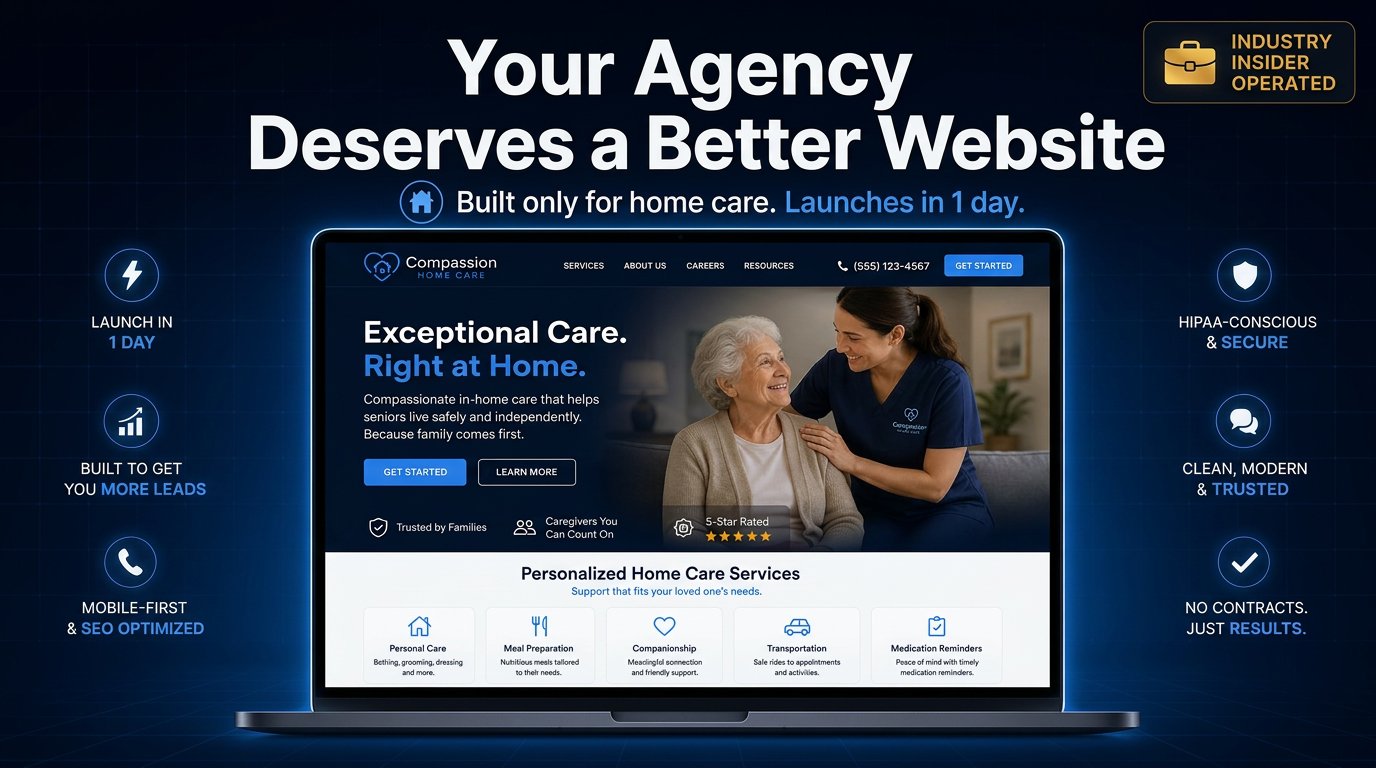
Think about the last time your agency needed caregivers. You probably posted on Indeed, texted your existing staff for referrals, maybe ran a Facebook ad. But here is what most home care owners never stop to consider: every single caregiver who hears about your agency is going to Google you first. They land on your website, take a look around, and make a snap judgment about whether working for you sounds worth their time.
If your website is designed only to attract clients, you are invisible to the talent market. Your Careers page is not a checkbox. It is a recruiting pitch running 24 hours a day, 7 days a week, at zero ongoing cost. Here is how to build one that actually works.
Caregivers are job shoppers, just like clients
The home care workforce is in high demand and short supply. A good caregiver who decides to look for a new position will often apply to four or five agencies in an afternoon. What separates the agencies that attract great applicants from the ones that get the leftovers? Perception. Your website creates it before you ever speak to a single candidate.
A polished, welcoming Careers page signals that you are a professional organization that takes its staff seriously. A generic "Submit your resume here" form signals that caregivers are an afterthought. Which agency would you apply to?
What your Careers page must include
A real headline — not "Join Our Team." Something like "Build a Career That Matters" or "Caregivers Who Want More Than Just a Job Start Here" stops scrolling and speaks directly to motivated candidates.
Your culture and values up front — caregivers want to know what kind of organization they are walking into. Share your mission in plain language, not corporate buzzwords.
Specific benefits, not vague promises — "flexible scheduling" means nothing without context. Be specific: weekly pay, paid training, mileage reimbursement, consistent client assignments. If you offer it, say so clearly.
Staff stories or testimonials — a paragraph from a current caregiver about why they chose you, written in their own voice, carries more weight than anything your marketing team could write.
A simple, fast application — every extra field you add costs you applicants. Ask for the essentials first and gather details during screening. A long form is a closed door.
A mobile experience that actually works — the majority of caregiver job searches happen on a phone. If your application is painful to fill out on a mobile screen, candidates abandon it.
The SEO angle most agencies miss
When a caregiver in your city types "caregiver jobs near me" or "home care jobs in [city]" into Google, is your agency showing up? Probably not, because most Careers pages have almost no content for search engines to find.
Adding dedicated pages for specific roles — a page for "Companion Caregiver Positions" and another for "Personal Care Assistant Jobs," with descriptions that include the city or counties you serve — can put your agency in front of candidates who are actively searching. This is free, ongoing recruitment powered by a single content investment.
A well optimized Careers page is not just a place to collect applications. It is a signal to Google, to candidates, and to the broader market that your agency is a serious employer worth considering.
Accessibility matters here too
Home care agencies serve seniors, and many of their caregivers come from communities where English is a second language. An accessible Careers page — one with clear fonts, good contrast, easy navigation, and ideally a multilingual chat option — opens your applicant pool dramatically. WCAG compliance is not just about client websites. It belongs on your recruiting pages too.
The Carey AI advantage in recruitment
One of the most effective things you can add to a Careers page is a chat assistant trained to answer candidate questions in real time. What is the pay rate? Do you offer part time shifts? How soon can I start? When a caregiver can get those answers instantly at 9 PM on a Sunday, they are far more likely to complete an application than if they hit a wall and move on to the next agency. That is exactly what the Carey AI assistant does, keeping your agency responsive even when your office is closed.
Recruitment is a marketing problem
At the end of the day, recruiting caregivers requires the same thinking as attracting clients: understand your audience, speak to what they care about, remove friction from the path to conversion, and show up where they are looking. Your website is already doing this for families. It should be doing it for your workforce too.
If your current Careers page is a single paragraph and a PDF upload button, you are leaving your most valuable recruiting channel completely untapped. The good news is that fixing it does not require a full site rebuild. Sometimes a single, well built page changes everything.